Showing posts with label trailer. Show all posts

Saturday, March 16, 2019

A Quiet Place - John Krasinski (2018)

All my life, I've associated fear with cinema. I don't know how much of that fear came from growing up in the era of Tobe Hooper's "Poltergeist," Wes Craven's "A Nightmare on Elm Street," etc. The boy-into-donkey sequence in "Pinnochio" traumatized me as did the trailer of "Poltergeist" which they played before "E.T." Children are easy to scare, at least I sure as hell was, but as we mature we become jaded, desensitized.

But once that element of menace is established, our throats are in the hands of these storytellers, we're at their mercy. To genuinely terrify grown-ups, filmmakers have to work hard to fill us with that much-desired dread. So many turn to gore a lazy response. There are much better ways to successfully thrill, even terrify, horror movie fans. The element of sound is a time-honored method of injecting that bit, turning a bore into an experience where we find ourselves holding our breath.

Right at the start of John Krasinski's "A Quiet Place" it's made clear that nobody here is safe. It's a world where humans are hunted. These blind terrors can hear anything, any small noise and that's how they find their prey, for food or for sport, it doesn't really matter. They can't see, but they don't have to. Their ears are that sensitive and the hunters are that fast.

The Abbot family, with three children just like any family you might come across. In the opening sequence, the Aboots strip a small grocery store/pharmacy for whatever food and medical supplies they need. When the youngest child of the family if he can take a toy, Lee Abbot (John Krasinski) gives it to him, putting a finger against his lips, warning the child to play with it quietly.

Of course, there are other Abbot children. One sister, too young to grasp the gravity of their situation but old enough to take batteries off the shelf to power up a toy. Later, the child turns the toy on, setting off flashing lights and loud sirens, violating the primary rule of survival. What happens next is some of the tightest seconds in recent memory. So now the Abbot family shares a trauma.

Flash forward one year. We can see from Lee's scavenged newspapers' headlines that these creatures have taken the entire planet. That they are indestructible. That they are the end of the world.

The Abbot family still lives in silence and fear. Lee's wife, Evelyn Abbot (Emily Blunt) is expecting a baby which is problematic, to say the least. How the hell could a family survive with a baby? They have managed to keep their children silent, but how can one expect that from an infant?

The rest of the film follows what should have been a typical day for the Abbots in this hopeless, new reality - how they find their food, how they contact their neighbours, how they manage to stay alive. How they learn to enjoy life while walking on a tightrope.

One thing more needs to said about this film - what separates "A Quiet Place" apart from other horror films is that the focus is not only on the monsters but its characters. We come to deeply care for the Abbot family.

"A Quiet Place," effectively pins down an atmosphere of un-breathable fear and epic panic right at the start. Krasinski takes us to a place where making a sound, even a small one, could be fatal. The premise takes us to a malevolent place, how could anybody survive?


Wednesday, April 4, 2018

On Body and Soul - Ildikó Enyedi (2017)

Tell me, how wonderful does it make you feel to watch an incredibly touching, romantic film? It can fill you up with an indescribable feeling you carry with you for hours, sometimes days. It's so intoxicating, you want to revisit it right away.

Where does that magic come from? Sure, you'll point to the screenplay, the directing, and the lovely performances. Some romances have a powerful charm and a gorgeous story running underneath everything that you really can't verbalize.

In these gems, we fall in love with the characters instantaneously. It's more powerful than what they call chemistry and it's something that you can't explain in words.

So when we are lost in a film like Abdellatif Kechiche's "Blue is the Warmest Color," Francois Truffaut's "Jules and Jim," Michel Gondry's "Eternal Sunshine of the Spotless Mind," or Tony Scott's "True Romance," (my favorite love story), what gives us that spark that makes these films so elegant and timeless?

In Ildikó Enyedi's "On Body and Soul," a young woman, Mária (Alexandra Borbély) starts her new job as a meat-inspector at a slaughterhouse. On her first day, she meets the man in charge, Endre (Géza Morcsányi), an older man, very quiet, who keeps him to himself.

On the surface, they don't seem to form any kind of rapport. But they quickly learn the two of them share their dreams.

Literally. When they sleep at night, they wander into a single dream. It's a very simple dream. Endre is a stag who comes across a doe, Mária. There's not much to it, they spend some time playfully and affectionate at a riverbank surrounded by mountains of snow.

It takes them days to realize it, but when they do, they have no idea how to respond. They are not instantly captivated by the other.

The story slowly starts its work. You realize that these two are either going to have to truly earn their relationship, along with our affection, or you're watching a bad movie.

Then they keep raising the stakes on each other. It's very subtle, powerful storytelling going on as they slowly build to the place where Endre and Mária can't and won't live without the other.

So no, they don't share that glow right from the beginning. It takes a while to do it, but Mária and Endre work hard to win our affection and when we've finally fallen in love with them, we are caught off guard. Emotionally, we live and die in every breath they share, in every touch.

"On Body and Soul" takes no shortcuts. It doesn't take for granted that these two, even given the

connection in their dreams, will be able to sustain, or even start, a relationship. It's right at the top of the list with "Blue is the Warmest Color" as one of the great romances so far this century.

And that makes a film a classic. It's why this film will endure.


Thursday, March 22, 2018

Suburbicon - George Clooney (2017)

You can easily laugh through some dark comedies. George Clooney's "Suburbicon," (based on a screenplay by the Coen Brothers, Clooney, and Grant Heslov) is a comedy in which, the fun and humor are juxtaposed with a backdrop of suffering that isn't funny at all.

Gardner Lodge (Matt Damon) is an ordinary man, as far as we can see, whose luck spirals downward to an alarming level of rot. Damon is the box office draw, but the Protagonist, the leading man if you will, is actually Nicky (Noah Jupe), Gardner's son.

Nicky is the single innocent in this story. He's the only character who's not an amoral wretch. At the start of the film, the kid is put through a traumatic experience. The sequence is excessively grim, the kind of content that even the darkest of most dark comedies wouldn't touch.

The boy is woken in the middle of the night and dragged down to the dining room. He is tied down by a couple of brutes. He sees his mother Rose, and aunt Margaret (both played by Julianne Moore) are tied down as well.

After a few minutes of intimidating threats, the brutes chloroform all of them.

When Nicky wakes up, he learns that his mother did not survive the attack. His father and aunt are fairly blasé about the incident.

Aunt Margaret moves in to help Nicky and Gardner get used to living without Rose. There may be something sinister behind that.

Rose's death starts a chain of unfortunate events that could very well toss the family right on its head. Nicky and Gardner are threatened throughout the film by nosey cops, gangsters and a corrupt insurance investigator looking to take the Lodges for everything they've got.

Watching Gardner and his sister-in-law Margaret's lives fall apart is hilarious. "Suburbicon" creates so many characters whose demise we gladly cheer for.

There is a secondary plot is focused on a black family, the Mayers, who move into the neighborhood. Nicky strikes up a friendship with Andy Mayer, the new black kid in town.

But the neighborhood doesn't just object to the family's arrival, it rages. As the Lodge family's safety is on the decline, the Mayers face a hostility from the town that simmers through the story and explodes at just the worst time.

It's wonderful how Clooney manages to slowly transform the normal people we were introduced to at the beginning into the sociopaths they really are. "Suburbicon" mirrors the place where the center of the morality of our country is right now, without sounding too self-righteous.

"Suburbicon" is about "Some very fine people," and how they devolve into monsters most wouldn't have recognized before.

The film is screamingly funny all the way through until the end, but it is decidedly disturbing at the same time. You've been warned.


Friday, March 16, 2018

Ingrid Goes West - Matt Spicer (2017)

Stalkers. Admit it, America, you're just as obsessed with them as they are about their targets. They're just fascinating. We wonder what exactly is wrong with them? But everybody is obsessed with celebrities, aren't they?  The difference is that we have the privilege of watching everything happen on Facebook, Twitter, Instagram, Tumblr, Live Journal and so many more. Whereas the Stalker has not only to know about their target, they must become friends with them in person.

From the start of "Ingrid Goes West," Ingrid's (Aubrey Plaza) insanity is established. We're shown what happens at the ending of a stalker/stalkee friendship.

She crashes a wedding, starts screaming at the bride and then throws acid onto her face. So I guess that makes Ingrid an anti-hero. 

After Ingrid is released from a mental health facility, she doesn't waste any time. She has a new crush. A celebrity on the internet, Taylor (Elizabeth Olsen).

Ingrid cashes out her late mother's life insurance and takes a trip all the way to California. She just has to be this girl's best friend, whatever obstacles come in her way.

When she gets there, she rents a room from Dan Pinto, (O'Shea Jackson Jr.), who can smell her instability right away. Nevertheless, he lets her have the room, lets her borrow his truck and sleeps with her.

Ingrid knows a lot about Taylor already through her online persona. She knows what she likes, where she lives and who she loves. She uses all this knowledge to squeeze into Taylor's life.

When Taylor's dog goes missing, Ingrid shows up on her doorstep, her beloved dog in Ingrid's arms. From there, Ingrid and Taylor's friendship takes off and then just glows.


They become very close very fast, share intimacy, party together. Taylor even introduces Ingrid to the delights cocaine has to offer.


When some secrets threaten to doom their friendship, things spiral downward very quickly and very hilariously. But we understand both of these characters throughout the film. We root for both of them and feel sorry for both in equal measure. 


Generally, there's only room for one dark comedy celebrated throughout awards season such as The Coen Brothers' "Fargo" in 1996 or Alejandro G. Iñárritu's "Birdman. in 2014." In 2017, out of all the dark comedies like George Clooney's "Suburbicon" and Armando Iannucci's "Death of Stalin," that honor went to Craig Gillespie's "I, Tonya."


"Ingrid Goes West" isn't one of the best Dark Comedies of the year - nor is "I, Tonya" for all that matters, but it's dark as hell and hilarious, while somehow managing to treat its characters with kindness. You can count on this film to entertain you amply for a couple of hours.


Monday, February 12, 2018

Thelma - Joachim Trier (2017)

As young adults or teenagers, when we encounter our first loves, it changes every part of us irrevocably. In some of us, the changes are  subtle. In others, however, the transformation slaps us in the face and recreates us into something we never would have believed.

The girls Joachim Trier presents us with in "Thelma" are quiet to start with, particularly Thelma (Eili Harboe). She's a young college student, starting life out on her own. Sort of. She's still tied to her religious yet demoralizing parents.

Thelma's father (Henrik Rafaelsen) is a grand manipulator. Whenever he tries to teach her a moral lesson, it always ends the same: Thelma lowers her head and starts to weep. These speeches spring up randomly in most of their conversations and they devastate Thelma.

Her mother (Ellen Dorrit Petersen) is a quiet, passive-aggressive woman who doesn't talk very much, but is clearly softly bullying the girl.

Thelma plows through, studying and going to classes. She hasn't really made any friends yet. A girl, Anja (Kaya Wilkins) sits with her one day while she's studying. 

Thelma's attraction to this girl kicks in right away. She falls to the floor having a non-epileptic seizure. She has no history of epilepticy or seizures of any kind. The doctors run tests, but don't find anything, so clearly, something else triggered the seizure. Like seeing her first love for the very first time. Put that together with Thelma realizing in a second that she likes girls it's no wonder why she reacted so strongly.

Thelma and Anja start to get closer as Thelma's desire for Anja rises. At the same time, Thelma's religious upbringing harmfully holds her back. At night, she kneels with her head against the wall and pleads with God to take away these sinful thoughts and urges. When her father finds about her sexual identity, he forces her to kneel with her head against the wall, pleading with God to remove these new, deviant desires. Thelma is profoundly lost.

The bulk of the film is about Thelma's choice. Does she bend to the so-called morality of her upbringing? Or is she going to hunt down the girl she loves dearly so they call start their relationship?

They clearly have a pure love between them. The passion that grows between them reminded me of Abdellatif Kechiche's deeply emotional "Blue is the Warmest Color."

Therein lies the trauma millions of young gay men and women experience. They can't let themselves love because something in their heads insists that who they are is wrong. So much unhappiness comes from love deprivation. Above everything in this world, love is what we need the most. And everyone deserves to have it.

"Thelma" looks at this problem without condemnation, for neither Thelma or her parents. Trier doesn't condescend to mocking her upbringing, her beliefs or her family, even when they're at their worst. That kind of kindness he shows to all of his characters carries this film and raises it up among others that explore this theme.

So yes, you should seek out "Thelma." Not just if you're a sucker for romance but if you love film or storytelling. This film is far too thoughtful to peg it into a genre.

Let  me say it as strongly as possible. "Thelma" is one of the great films of 2017.


Friday, February 2, 2018

Mudbound - Dee Rees (2017)

Sometimes, a film comes around, reaching for epic status. A great many of these are enthusiastic, but embarrassingly bad. Some actually do reach epic status.

Dee Rees' "Mudbound" is an ambitious film. It wants to be everything: a war story, a drama, but most of all, an acceleration of hatred between man against man, family against family, white against humanity.

When Ronsel Jackson (Jackson Mitchell) a black servicemen, comes home a hero from World War II, his family is ecstatic. His dad, Hap (Rob Morgan), is overjoyed when Ronsel tells him he intends to stay with his family, in Mississippi and work on the family's farm.

Of course, this is problematic to say the least. The Jackson family are tenants of the McAllen's, led by an inhuman patriarch, Pappy (Jonathan Banks). He doesn't miss an opportunity to make it clear to Ronsel that he doesn't care what respect or rights he had during the war. Ronsel is back here in Mississippi.

In fact, the whole McAllan family together represents a familiar "racism with a smile." They demand absolute servitude from the Jacksons, even as the head of their family, Hap is incapacitated by a broken leg, and expected to be working.

Meanwhile, Ronsel starts a strange kind of friendship with Jamie, (Garrett Hedlund), one the McAllan boys coming back from the war as well. They bond over their partying, fighting, close calls, womanizing, the toll killing people can take on one's soul, and their shared shell-shock.

At one point, there's a rare scenario when the McAllans are in a position to humble themselves and ask a desperate service from the mother of the Jackson family, Florence (Mary J. Blige). The McAllan children have gotten sick and they can't reach a doctor. Laura, (Carey Mulligan) understands Florence knows how to care for them. Knowing that her family won't get any kind of thanks, that the McAllan family will continue to demand servitude, Florence agrees to help. Yes, the McAllans are monsters, but you can't take that out innocent children. Of course, when the danger is passed, things continue as they were.

Ronsel and Jamie continue their friendship, getting closer as they spend more time with each other. But there's a dark shadow lurking over them: Pappy McAllan. The man's cold, deliberate malice is deadly. More-so than Jonathan had ever dreamed.

When the story reaches its boiling point, every single character is hurt. And what's truly sad is that these tragedies have no moral. They're empty and meaningless. None of it was necessary. In the end, there's just loss and grief.

But this film is bigger than the violence. With the backdrop of Belgium and other WWII stages, "Mudbound" covers decades in these families' lives. It covers a love triangle, the increasing boldness of the Ku Klux Klan, the sparks of the Civil Rights movement, a story of vengeance, of fathers and sons and  it nails each of these smaller story contained within.

The film reaches for epic status and touches it.

And Jonathan Banks deserves recognition for his work as he brings white hatred and quiet savagery to the screen personified on his very face. I'm still frightened by the thought of him.


Tuesday, January 16, 2018

The Shape of Water - Guillermo del Toro (2017)


I have to tell you. My head is swimming. Do you know the kind of feeling you get when you've just been introduced to a book or a song or a film that was so beautiful, you actually get light-headed?

I had that experience twelve years ago when I saw Guillermo del Toro's "Pan's Labyrinth." When the movie was over, I froze. I was so overwhelmed that I sat right in my seat until someone came to clean the theatre.

And that's the feeling I'm experiencing right now. I just finished watching del Toro's "The Shape of Water."

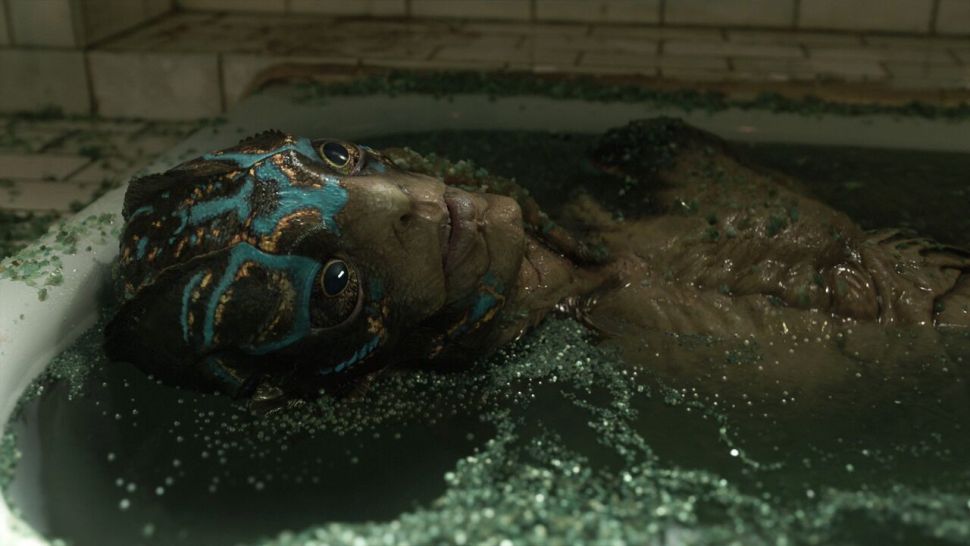
The film is about a mute cleaning lady who works at a top-secret government facility in the '60's. Her world is changed forever when she comes across the U.S.'s newest specimen.

He looks like a swamp monster. He came from the Amazon. The government wants to examine him to see if holds any information they can use in the race to the moon against the Soviets.

You see the Soviets sent a dog to space and now we have to one-up them. So they found a creature with a different physical make-up than humans to see if he was fit for space travel. The government plans to either shoot him into space or vivisect the creature to see if they can't see what makes him tick. They just want any clues that can help them speed up their race to the moon.

Meanwhile, Elisa (Sally Hawkins), a mute cleaning lady, comes across the creature and doesn't see anything in him but a graceful soul, cut off from everything in the world. Dumb from birth, Elisa knows exactly how he feels.

Her friends, Zelda (Octavia Spencer) a co-cleaning lady at the base, and an older man Giles (Richard Jenkins) understand how she feels. And that says something about what kind of friends they are. If your friend came to you with a story about how she's attracted to a swamp-thing, how sympathetic would you be? Or would you dismiss her as a freak?

But Elisa's friends accept her feelings at face value and agree to help her rescue him.

They are up against Richard Strickland (Michael Shannon), the agent in charge of this project. He looms over the whole film like a dark shadow. He is a sadist and, when all is said and done, is eager to destroy the creature Elisa has fallen for.

The film evolves into an elegant fantasy/love story.

It's about how the forces of evil can take the shape of the institutions we are expected to trust and accept. And conversely, how the misfits are often the good guys.

One of the most brilliant pieces to this films is Sally Hawkins' performance. Del Toro asks her to go to places most actress have never been to and she dives into her character, her innocence, boldness and goodness seamlessly.

Watching all of this wonder through her eyes is part of what makes this film so exceptional.

So please, seek out and enjoy this intense, dark, beautiful fairy tale.


Wednesday, October 25, 2017

The Girl With All the Gifts - Colm McCarthy (2017) Some Say Children Are Our Future. I Say They Are Bloody Disgusting

I have not watched a zombie movie in a couple of years now. Face it. The universe has been saturated with zombies everywhere, in TV, movies and video games. We can't even read Jane Austen without bloody zombies being crammed down our throats. I, for one, am burned out.

Still, I have wished for a zombie flick that could peak my interest and rekindle that fire I used to have for those brain-eaters. So I watched "The Girl With all the Gifts" in the hope of the genre hadn't been ruined forever for me. I was drawn in by several hooks in this ambitious zombie flick.

Right at the start of "The Girl with all the Gifts," we know that we are in a dark universe. We're met with children who are treated poorly. Their heads are strapped down tight in wheelchairs, pushed around by soldiers who, mostly, won't speak with them or acknowledge them. The soldiers just refer to the children as "abortions".

It's obvious that these children are capable of the most wondrous kinds of art and intelligence. Melanie (Sennia Nanua) is one of these children. She just might be the brightest among them. Melanie's teacher, Helen, (Jemma Erterton), is willing to risk her life to nurture these kids.

Still, it's curious how government goes to great efforts to educate these little bastards, or abortions, as the soldiers like to call them. And why do all the grown-ups seem so terrified?

Every zombie movie has an "oh crap" moment when we see the military or doctors or whoever's in charge make a stupid mistake allowing the zombies take over in a matter of minutes. If it's a good movie, these moments are chilling.

Then here comes the "oh crap" moment.

We watch the moment from Melanie's POV in an operating room, knowing the true chaos, bloody and deadly is right outside their door, just in our periphery.

Normally films like these are about protecting weak children from the monsters. This film flips that coin. "The Girl With all the Gifts" is about child zombies. At least some of them can reason and the story is told from a zombie's point of view.


Somehow, through all the carnage, Melanie manages to escape with Helen, a soldier, (Paddy Considine) and the woman in charge of the medical experiments, Dr. Caldwell (Glenn Close).

Helen and Melanie escape together, each helping the other through the genocidal battle.

Melanie, is more than an infected zombie. She actually might be their salvation. Melanie protects the group from zombie attacks. Monster or no, Helen nurtures some maternal feelings toward Melanie.

"Neonates" is the term for babies born zombies. Babies of infected mothers who ate themselves out of the womb. Melanie is one of these children. 

"The Girl With all the Gifts" is about the value of life. Why do some people deserve to live, violent scavengers or not, while others can be cast aside because of the way they're born? It's hyperbolic and an extreme example used to prove a point, but that point is a good one. With all of man's ambition, this need for power comes with a very real danger that could literally end everything.

The telling point lies in a question Melanie asks Helen. Why should the humans be the ones allowed to keep their place on their planet? She argues that since zombies are now sentient creatures, they have as much right as humans to dominate the world. 

Now, I don't want to be the guy who's rooting for the zombies, but I had to stop and think. Why should human life as a species take precedence over a world run by zombies? As a human, of course I want us to remain dominant. But as I address the point of view of a sentient zombie like Melanie, I can't think of a good argument to retort.

Then I remembered, they're zombies. They eat brains. Go humans.

Tuesday, August 29, 2017

Split - M. Night Shyamalan (2017)


I approached M. Night Shyamalan's "Split" with mixed feelings. I had heard the film was the best work Shyamalan had done since his 2000 masterpiece, "Unbreakable."

But I had a problem with the film's concept. Until now, I had refused to watch the film because it looked like an excuse to exploit the mentally ill for plot twists, backstories and any other cheap tricks one could think of.

The story centers around three teenage girls (Anna Taylor-Jo, Haley Lu Richardson and Jessica Sula) who have been kidnapped by Kevin, (James McAvoy) a man with Dissociative Identity Disorder (DID.) DID is better known as the term for MPD (Multiple Personality Disorder.) Kevin has twenty-three personalities and they all wait for a twenty-fourth personality known as "The Beast." We're meant to think there is something Messianic transpiring in his head.

The personality in charge at the time when he snatched the girls was violent and deliberate in the act. He was not frightened. Every movement was bold.


Then, as the man continues to interact with the girls, other personalities, kinder ones, have taken over.

As an actor, McAvoy deftly takes all alters, benign and malicious, and balances them like a pro.

And so goes the movie. They try to get help from some of Kevin's alters while trying not to get caught by some of the others. Before the story is wrapped up tight there are twists and turns we do not see coming.


All of the events thus far, all that we see of the other personalities, Kevin does out of fear for the oncoming twenty-fourth personality, known as "The Beast."

I will concede that "Split" is Shyamalan's best work since "Unbreakable."

It is a perfect psychological horror film.

Also, "Split" is the single most offensive movie I have ever seen.

Why is the concept of DID so frightening? Is it just morbid fascination? I have to admit Shyamalan has crafted an incredibly tense film wrapped around the phenomenon.

I think the idea of multiple personalities opens up a world of possible scenarios, especially to those who have no concept of what mental illness is. We don't even know who the villain is here. He or she hides in plain sight. The situation could blow up anytime because the villain is right there and can jump out at any scene.

Shyamalan uses his own presumptions of people with DID and crafts them into an accomplished film.

Not only does Shyamalan reveal himself as somebody who knows nothing about mental illness, he exploits DID and other disorders for entertainment. It  villainizes those who struggle with mental illness.

Shyamalan sees patients of this type of illness as sources of potential violence. He uses them to frighten us, just as our world is trying to get rid of the stigma of mental illness.

People with mental illness are not killers nor are they "Beasts." The name he gave the villain, Beast, identifies all people with DID or mental illness as potential monsters of whom we all should be afraid.

Kevin talks of all his personalities siting in one place together in a room with chairs. Shyamalan would have us believe that one with DID can switch from one personality to another at will. Medically and psychologically this is incorrect, as it is not particularly typical for DID patients to have that much control over their alters. Not only that, but this mindset is dangerous and irresponsible.

And not for nothing, but Shyamalan does not limit his prejudices to the mentally ill. "Split" is also unbelievably misogynistic, homophobic and most of all, trans-phobic.

And just as an aside, I don't usually address matters like this, because of my love for hardcore material, but as a father, I have to tell you that "Split" should been rated 'R.' I would never take a thirteen-year-old to see it.

And despite how clever of a thriller "Split" is, I can not, in good conscience, recommend this movie.

But I must admit, I am damn excited about the prospect of revisiting the "Unbreakable" universe in the near future.

David Dunn is an unsung hero.