From my vantage point, Martin McDonagh's film, "Three Billboards Outside Ebbing, Missouri," was unexpected. It had popped into the movie theaters around the start of December, without a lot of promotion. Or else I haven't been paying attention as carefully as I should.
Well, it has all eyes on it now, and rightly so.
Seven years after her daughter is raped and murdered, Mildred (Francis McDormand), has lost her patience with the police and their ineffective investigation.
Rather than repeatedly going to the cops, Mildred decides to take matters into her own hands. She takes out advertising space on three billboards which together, spell out, "Raped while dying" "And still no arrests?" "How come, Chief Willoughby?"
To say this causes a stir would be a silly understatement. The entire town comes rushing to defend Chief Willoughby (Woody Harrelson).
Sadly, in their minds, Mildred turns from a sympathetic mourning mom to a shrew throwing blame on who the towns considers to be a good man.
One the cops under Willoughby's wing, Dixon (Sam Rockwell), takes the situation very personally. To Dixon, Willoughby is the ultimate father figure, cop, and man, and how dare Mildred say anything bad about the man?
Things get ugly very quickly. It starts with just a small tit-for-tat between Mildred and Dixon then whirls up to the exercising of true hatred and then the story explodes.
"Billboards" is a cautionary tale about vengeance. The films demonstrates what can happen when even the most ordinary people allow rage and hatred to burn hotter and hotter.
I do understand why everybody is making such a big deal out of this film. Firstly, the performances by Frances McDonald and Sam Rockwell are a marvel.
And Woody Harrelson excels as he plays the world-weary Chief Willoughby.
As far as the story goes, it's a beautiful, escalating screenplay. In many films structured like this, the acceleration is sloppy and the movie loses its way. But McDonaugh takes us through what someone is capable of in their grief and holds it all together. That's why the film more than the ordinary eye-for-an-eye movies.
"Three Billboards Outside Belling, Missouri" may look like a run of the mill film of escalating one-upsmanship, but it's so much more than that. The performances are close to perfect. Pair that with an incredibly subtle but intensely emotional screenplay as its foundation, and you have a small masterpiece.
So yes, "Billboards" lives up to the hype. It actually is among the best pictures of the year.
Andy Muschietti's elegant adaptation of Stephen King's "It," in summer 2017, was warmly accepted by critics and audiences alike. But it was a horror film and didn't really spark of a debate on sexual politics or the nature of fear.
Most people don't associate horror films with social messages, but there are exceptions.
In February 2017, Jordan Peele offered up a perfect retort to our current national policy of "Trickle Down Racism." "Get Out" was the most political, meaningful film of 2017.
Likewise, last summer's explosively popular "It" has a lot to say about the feminism inherent in the way Beverly (Sophia Lillis) is portrayed. "It" is a progressive and unique look at the sexualization that every woman faces as they come of age.
The thought of Beverly's transformation from child hood to womanhood terrifies Beverly. The bulk of the film is relatively bloodless. The boys' fear comes in the form of sickness and suffers. But blood symbolizes Beverly's fear. When the concept of blood, after buying her first tampons, enters her life, the attention, even subservience, of all of her male friends shows its bizarre nature. They clean up her menacing, bloody bathroom without question. They would never question it. No matter what she said, the boys would be her servants. Why?
Critics of the film and the 1986 novel accuse the story of sexualizing children. To the contrary, it offers a decidedly woman's point of view that every teenage boy needs to see. It takes the focus off themselves and makes them think of what it really is to be a woman, or at least the hurdles Beverly faces.
An article from last summer on the website by Aja Romano: "It: the most surprising scene in the movie has nothing to do with clowns,"goes into a very particular and open study of the imagery of the film. The article digs down into a young woman's fear and how that fear is so bloody. Literally.
Do you like coming-of-age movies where a self-conscious teenage girl is surrounded by high school malevolence and simple and thick sleazebags finds her "inner-cool?" Well, you are in luck, my friend. When you take a casual look at "Lady Bird", it seems formulaic, but it feels more natural than your typical cookie-cutter film. But the film has a voice that can't be dismissed as an element of any genre.
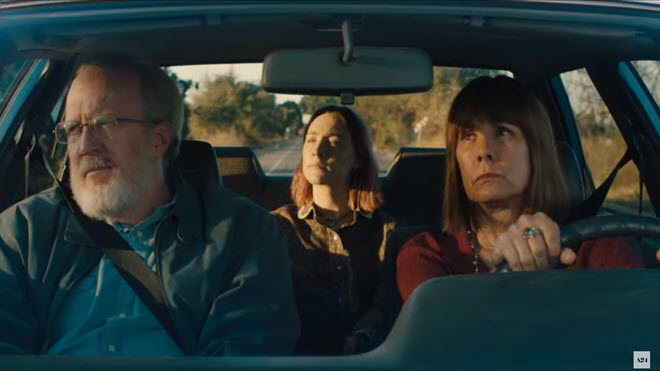
"Lady Bird" is the story of Lady Bird (Saoirse Ronan), a young wallflower who feels like at the age of seventeen, she is already stuck in a never-ending rut. And she craves adventure. More than anything, she wants to get the hell out of Sacramento. Of course, her best chance is college. She's set on New York and is willing to almost anything to get there. Standing in her way is her mother (Laurie Metcalf), who, no matter what, is determined to make her daughter go to a Catholic school. Watching the bittersweet relationship Lady Bird has with her mother is compelling. The two of them have excessively strong wills and fight constantly. And they turn on a dime, from the gentle way she holds a crying Lady Bird to punishing her by refusing to talk to her.
The unconditional love between Lady Bird and her father, Larry (Tracey Letts) makes the family dynamic so fascinating to watch. He serves as the one constant in her life.
Aside from her home life, the tension between Lady Bird and her two romantic interests make for some of the very best dry and ironic comedy I've seen in a while.
Gerwig's spirit and tone is quickly becoming an important voice to be reckoned with. She has matured since her collaboration with Noah Baumbach on his masterpiece, "Francis Ha." I'm not discounting "Frances Ha", in fact it's one of my favorite film of the decade. "Lady Bird" shows a fresh, new voice we haven't heard before. Greta Gerwig's directorial debut stands on the shoulders of the work she has done with Baumbach, but she has a striking, raw authentic voice that's rare in modern cinema.
And Saoirse Ronan is so endearing, she could easily become this
generation's Molly Ringwald.
I've seen the film twice now and it still feels crisp. On its face, "Lady Bird's" story should feel ordinary. What makes it great is the characters Gerwig has created and their quirks and dialogue that is freshly built for each one differently.
And Saoirse Ronan is so endearing, she could easily become this
generation's Molly Ringwald.
I can see Gerwig with a career as a kind of indie John Hughes. But I don't see her sticking to any kind of mold. Her writing is too fresh to fall into that trap.
Since 2012's "Frances Ha", which she co-wrote with Baumbach, I've been curious to see what we can expect from Gerwig and if "Lady Bird" is an indicator of things to come, the future of indie comedy is bright indeed.
I have to tell you. My head is swimming. Do you know the kind of feeling you get when you've just been introduced to a book or a song or a film that was so beautiful, you actually get light-headed?
I had that experience twelve years ago when I saw Guillermo del Toro's "Pan's Labyrinth." When the movie was over, I froze. I was so overwhelmed that I sat right in my seat until someone came to clean the theatre.
And that's the feeling I'm experiencing right now. I just finished watching del Toro's "The Shape of Water."
The film is about a mute cleaning lady who works at a top-secret government facility in the '60's. Her world is changed forever when she comes across the U.S.'s newest specimen.
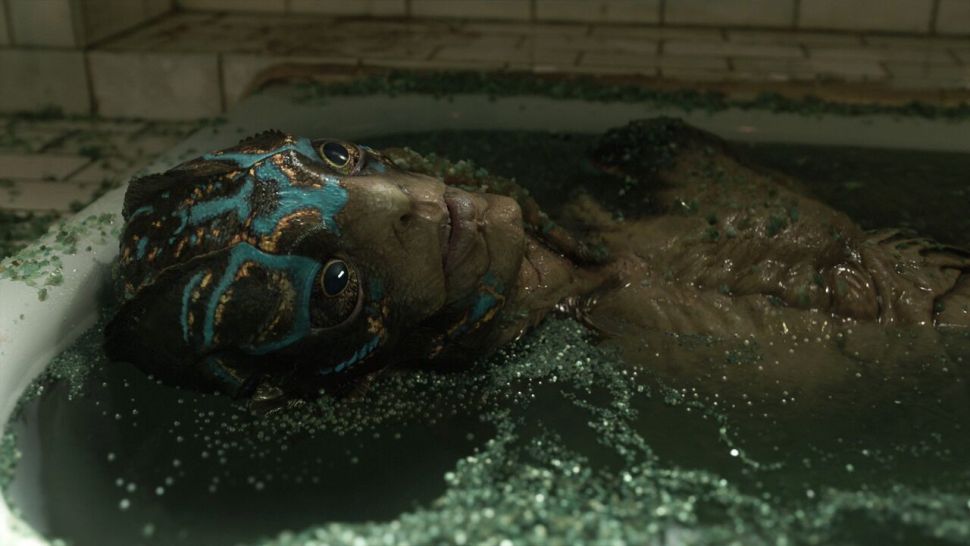
He looks like a swamp monster. He came from the Amazon. The government wants to examine him to see if holds any information they can use in the race to the moon against the Soviets.
You see the Soviets sent a dog to space and now we have to one-up them. So they found a creature with a different physical make-up than humans to see if he was fit for space travel. The government plans to either shoot him into space or vivisect the creature to see if they can't see what makes him tick. They just want any clues that can help them speed up their race to the moon.
Meanwhile, Elisa (Sally Hawkins), a mute cleaning lady, comes across the creature and doesn't see anything in him but a graceful soul, cut off from everything in the world. Dumb from birth, Elisa knows exactly how he feels.
Her friends, Zelda (Octavia Spencer) a co-cleaning lady at the base, and an older man Giles (Richard Jenkins) understand how she feels. And that says something about what kind of friends they are. If your friend came to you with a story about how she's attracted to a swamp-thing, how sympathetic would you be? Or would you dismiss her as a freak?
But Elisa's friends accept her feelings at face value and agree to help her rescue him.
They are up against Richard Strickland (Michael Shannon), the agent in charge of this project. He looms over the whole film like a dark shadow. He is a sadist and, when all is said and done, is eager to destroy the creature Elisa has fallen for.
The film evolves into an elegant fantasy/love story.
It's about how the forces of evil can take the shape of the institutions we are expected to trust and accept. And conversely, how the misfits are often the good guys.
One of the most brilliant pieces to this films is Sally Hawkins' performance. Del Toro asks her to go to places most actress have never been to and she dives into her character, her innocence, boldness and goodness seamlessly.
Watching all of this wonder through her eyes is part of what makes this film so exceptional.
So please, seek out and enjoy this intense, dark, beautiful fairy tale.
I have not watched a zombie movie in a couple of years now. Face it. The universe has been saturated with zombies everywhere, in TV, movies and video games. We can't even read Jane Austen without bloody zombies being crammed down our throats. I, for one, am burned out.
Still, I have wished for a zombie flick that could peak my interest and rekindle that fire I used to have for those brain-eaters. So I watched "The Girl With all the Gifts" in the hope of the genre hadn't been ruined forever for me. I was drawn in by several hooks in this ambitious zombie flick.
Right at the start of "The Girl with all the Gifts," we know that we are in a dark universe. We're met with children who are treated poorly. Their heads are strapped down tight in wheelchairs, pushed around by soldiers who, mostly, won't speak with them or acknowledge them. The soldiers just refer to the children as "abortions".
It's obvious that these children are capable of the most wondrous kinds of art and intelligence. Melanie (Sennia Nanua) is one of these children. She just might be the brightest among them. Melanie's teacher, Helen, (Jemma Erterton), is willing to risk her life to nurture these kids.
Still, it's curious how government goes to great efforts to educate these little bastards, or abortions, as the soldiers like to call them. And why do all the grown-ups seem so terrified?
Every zombie movie has an "oh crap" moment when we see the military or doctors or whoever's in charge make a stupid mistake allowing the zombies take over in a matter of minutes. If it's a good movie, these moments are chilling.
Then here comes the "oh crap" moment.
We watch the moment from Melanie's POV in an operating room, knowing the true chaos, bloody and deadly is right outside their door, just in our periphery.
Normally films like these are about protecting weak children from the monsters. This film flips that coin. "The Girl With all the Gifts" is about child zombies. At least some of them can reason and the story is told from a zombie's point of view. Somehow, through all the carnage, Melanie manages to escape with Helen, a soldier, (Paddy Considine) and the woman in charge of the medical experiments, Dr. Caldwell (Glenn Close). Helen and Melanie escape together, each helping the other through the genocidal battle. Melanie, is more than an infected zombie. She actually might be their salvation. Melanie protects the group from zombie attacks. Monster or no, Helen nurtures some maternal feelings toward Melanie.
"Neonates" is the term for babies born zombies. Babies of infected mothers who ate themselves out of the womb. Melanie is one of these children. "The Girl With all the Gifts" is about the value of life. Why do some people deserve to live, violent scavengers or not, while others can be cast aside because of the way they're born? It's hyperbolic and an extreme example used to prove a point, but that point is a good one. With all of man's ambition, this need for power comes with a very real danger that could literally end everything. The telling point lies in a question Melanie asks Helen. Why should the humans be the ones allowed to keep their place on their planet? She argues that since zombies are now sentient creatures, they have as much right as humans to dominate the world. Now, I don't want to be the guy who's rooting for the zombies, but I had to stop and think. Why should human life as a species take precedence over a world run by zombies? As a human, of course I want us to remain dominant. But as I address the point of view of a sentient zombie like Melanie, I can't think of a good argument to retort. Then I remembered, they're zombies. They eat brains. Go humans.
Most of my friends, who know much about film anyway, are disciples of Darren Aronofsky. I did not care for his work. In fact, "Requiem for a Dream" remains one of my least favorite films ever.
Then a magical thing happened. He surprised the hell out of me with "Black Swan." It's nothing less than a work of elegant magic.
Since then, my interest in Aronofsky as artist was piqued. I watched his other films, I even gave "Requiem for a Dream" another shot. This has led to repeated disappointment.
So every time I see he has a film coming out, I'm wary, even about a film that looks as compelling as "mother!", I'm curious to see if he has made his second great film.
I'll try not to be heavy on the allegorical language, but that's easier said than done. I'll do my best.
"mother!" is a very old story. The oldest. In the beginning, was Him (Javier Bardem.) He discovers a beautiful crystal and He is in a beautiful home with a woman in his bed known to us as Mother (Jennifer Lawrence).
He and Mother live in an intimate dream. They are clearly so deeply in love that neither of them needs anyone else. The crystal He discovered seems to be the only thing they truly need. He keeps it in a special, somewhat restricted room.
He is a writer. The film is vague on what kind of writer or His status. We only know that His work is significant.
Mother's role in the dream is constructing the house that He had lost in a cataclysmic fire. She does a wonderful job, building the building's structure back and taking care of the decorations inside. Her attention to detail is impressive. There is even beauty in the way she blends earth tones. Such delicacy just with browns.
It's a paradise until Man (Ed Harris) shows up at their door. While Mother is wary, He welcomes Man as if he were a long lost friend. The term "mi casa, su casa" is more than just an expression to Him.
When Woman (Michelle Pfeiffer) shows up, she is accepted as well. After all, she is Man's wife. Despite Mother's objections, He insists they put the two up because they have nowhere else to go.
Things change when Man and Woman wander into His personal room to get a better look at His crystal. The two of them break it to shards, leaving Him beside Himself. He scoops up the pieces, clutching them so tight, blood runs out of his fists. He orders them out of the room, but does not make them leave the house because again, they have nowhere to go.
He closes off the segregated room, and life goes on. But the crystal is irrevocably gone. Of course that means unbearable wickedness awaits.
Man and Woman's sons show up, running for their parents, already in a shouting match about some kind of financial grudge. The Oldest Son and Younger Brother fight until Oldest Son beats Younger Brother to death.
Of course, friends and family of Man and Woman come to the house to comfort them. To Mother's horrified disbelief, He welcomes them all to celebrate, mourn and stay. Even His publisher (Kristen Wiig) contributes to the riot as a monstrous herald.
This leads to chaos and the rest of the film plays out the dangers of His love for people even as they destroy everything He and Mother have. The third act of "mother!" has haunted (I know, strong word, but apt) me more than practically anything I've seen in cinema, period.
And as gorgeous as this allegory is, there's something you should bear in mind before you watch it. "mother!" is a horror film. Be careful.
I saw the film twice and waited to write about it because I've been quite obsessed and I wanted to get some distance before I tried to make sense of it to put my thoughts and feelings into words.
The allegory is fairly obvious, but what isn't is how it's going to work into one's world view.
For me, "mother!" is a private film, as it meditates on my faith.
I don't know exactly what Aronofsky believes, but I found the movie both reverent and troubling. He's absolutely right about how human nature has been slowly destroying mother nature from the beginning. And we're not only talking about the ruins our physical world is in right now. Aronofsky also submits that humans are also responsible for every kind of evil. And he's right that we are responsible for original sin.
Here's where I can not agree with Aronofsky. He has characters to signify everyone and everything in our faith except for Satan. A lot of you may laugh at me when I say I believe in Satan, but I do.
How could anybody in their right mind look back on the last century and maintain that he doesn't exist?
The concept that Earth is a phoenix is an intriguing one that I still haven't formed an opinion about. There's a fascinating discussion to be had about that prospect.
I was deeply touched by His love for the adoring, riotous and destructive people. He loves them more than his creation. More than mother. Even more than his only Son.
Like I said, "mother!" is intensely personal, so you'll have to watch it and put it together yourself. But do go and see the film. It wasn't nearly as beautiful as "Black Swan", but how many movies are?
There are so many pretentious adjective words I could throw around to impress you, but I'll just say this. There are good movies and there are bad movies and we spend a lot of time criticizing and adoring them. "mother!" is so much more than that. The dialogues the film is sure to open up revisions of exactly what we believe about God.
You can't really say that about many films. But this one is that important.
I've heard this film referred to as heretical, but that's just not so. It's not only worth watching, it's worth reflection.
Isn't this a special week? In the first week in October 1994, my life changed twice. On Wednesday, my firstborn son was born.
Then my mother-in-law came to town to help my wife learn about taking care of an infant. On Friday, October 7,1994 she said she would watch the baby and that my wife should get some sleep. Then she told me I should go relax for a couple of hours and just go to the movies.
My choice was obvious. Quentin Tarantino's "Reservoir Dogs" had been released just two years before, and had quickly became one of my favorite movies. So I went to see "Pulp Fiction."
You all know what that means because you all have seen the movie. It changed everything. Not just how films are made, but how the public consciousness receives films.
So happy birthday, "Pulp Fiction" and thank you Quentin for your gift to the world.
 From my vantage point, Martin McDonagh's film, "Three Billboards Outside Ebbing, Missouri," was unexpected. It had popped into the movie theaters around the start of December, without a lot of promotion. Or else I haven't been paying attention as carefully as I should.
 Rather than repeatedly going to the cops, Mildred decides to take matters into her own hands. She takes out advertising space on three billboards which together, spell out, "Raped while dying" "And still no arrests?" "How come, Chief Willoughby?"
 One the cops under Willoughby's wing, Dixon (Sam Rockwell), takes the situation very personally. To Dixon, Willoughby is the ultimate father figure, cop, and man, and how dare Mildred say anything bad about the man?
 "Billboards" is a cautionary tale about vengeance. The films demonstrates what can happen when even the most ordinary people allow rage and hatred to burn hotter and hotter.
 "Three Billboards Outside Belling, Missouri" may look like a run of the mill film of escalating one-upsmanship, but it's so much more than that. The performances are close to perfect. Pair that with an incredibly subtle but intensely emotional screenplay as its foundation, and you have a small masterpiece.